The latest news relevant to you and your business

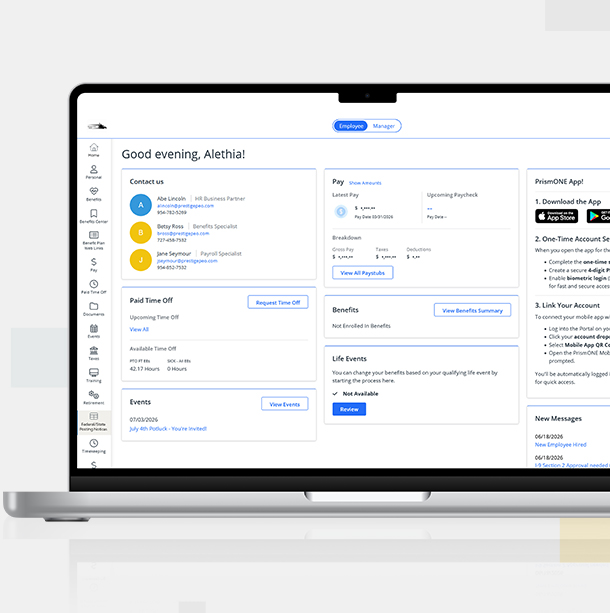
New PrestigePRO Enhancements Designed to Improve Visibility, Efficiency, and Everyday Management
At PrestigePEO, we’re committed to delivering innovative solutions that help clients manage their workforce with greater confidence and efficiency.
In the coming weeks, we’ll begin rolling out a series of enhancements to the PrestigePRO Manager Experience to improve visibility, simplify common tasks, and make it easier to access the information managers rely on most.
To ensure a successful transition, these enhancements will be introduced in phases, accompanied by resources, communications, and support designed to help clients make the most of these new capabilities.
As we continue investing in technology and innovation, our goal remains the same: delivering a smarter, more intuitive experience that supports your business and your people.
If you have questions in the meantime, please contact your dedicated HRBP.
Preparing for a Successful Open Enrollment Season
Working Behind the Scenes to Support Your Next Benefits Renewal
Open Enrollment season will be here before we know it, and our teams are already hard at work preparing for the months ahead.
From planning resources and educational materials to technology enhancements and client support, we’re focused on making this year’s renewal experience as seamless and informative as possible. As preparations continue, we’ll share additional communications, resources, and guidance to help employers and employees navigate Open Enrollment with confidence.
We look forward to supporting you every step of the way. Stay tuned for updates!

EEOC Shifts Direction with More Changes Expected
EEOC Rescinds Longstanding Affirmative Action Guidance
On June 30, 2026, the U.S. Equal Employment Opportunity Commission (EEOC) announced it is rescinding its 1979 interpretive guidelines on “appropriate” affirmative action under Title VII of the Civil Rights Act, along with Section 607 of its Compliance Manual. The final rule implementing the rescission was published on July 6, 2026, and took effect immediately.
What Changed
The rescinded guidelines previously described circumstances under which employers could voluntarily adopt affirmative action plans without violating Title VII. The EEOC concluded that the guidelines conflicted with the text of Title VII and with Supreme Court decisions issued over the four decades since the guidelines were written. With the guidelines withdrawn, employers can no longer rely on them as a defense under Title VII for actions taken after the effective date.
What the Change Does Not Do
The rescission does not amend Title VII and does not automatically make all voluntary affirmative action plans or diversity, equity, and inclusion (DEI) programs unlawful. Title VII’s core prohibition on discrimination based on race, color, national origin, sex, and religion is unchanged, and it continues to protect all employees equally.
What This Means for Employers
- Review any voluntary affirmative action plans, diversity initiatives, or hiring programs designed in reliance on the former guidelines;
- Ensure employment decisions rest on consistent, transparent, job-related criteria;
- Seek legal review before adopting or continuing programs that take race or sex into account; and
- Continue to monitor state and local law, which may impose requirements that differ from federal law.
EEOC Seeks to Discontinue EEO-1 Reporting
On July 6, the EEOC announced that employers can expect a formal proposed rule this month to eliminate the EEO-1 reporting requirement, with comments due in September and final action anticipated later in 2026.
According to a May 14 submission to the Office of Information and Regulatory Affairs (OIRA), the EEOC has sent a significant proposal to the White House to eliminate the EEO-1 as well as other reporting requirement entirely, including Forms EEO-2 through EEO-5. The development comes as employers still await the opening of the annual EEO-1 reporting portal, leaving uncertainty about whether it will open at all for this reporting year. This requirement has historically obligated large employers with 100 or more employees and certain federal contractors with at least 50 employees to annually report employee demographic data to the Equal Employment Opportunity Commission by job category, sex, and race/ethnicity.
Although the EEOC has indicated that EEO-1 reporting requirements will be rescinded, employers should be aware that the change is not yet effective. The agency must still complete the federal rulemaking process, including publication of a proposed rule and a notice and comment period, before a final rule can take effect. Employers are encouraged to evaluate their existing employee data including ensuring job titles are categorized correctly, to assist in the event the EEOC opens the reporting portal for this 2025 data collection.
EEOC Rewriting Strategic Priorities Through 2030
The EEOC has approved a draft strategic plan outlining its enforcement priorities through fiscal year 2030. The plan offers useful insight into how the agency is likely to investigate, negotiate, and resolve cases over the next four years. The plan highlights five key areas of focus.
These areas include:
Systemic Investigations Carry Higher Financial Stakes
The EEOC has set a clear benchmark for its Systemic Program. In 80% of systemic investigations where it finds cause, the agency aims to obtain both targeted equitable relief and at least $1 million in monetary relief. This signals a more aggressive approach to systemic cases, or those involving broad impact across an industry, company, or geographic region. Employers with multi-location operations or industry-wide practices should expect heightened scrutiny and prepare for the possibility that systemic findings may lead to substantial settlements. Higher education, technology, and staffing employers appear especially likely to draw attention, as do businesses with DEI programs or religious discrimination allegations.
Equitable Relief Is Becoming the Standard Request
The plan targets a goal of 97% of all conciliation agreements and litigation outcomes to include specified, equitable relief, or non-monetary remedies that extend beyond financial penalties. Employers should expect the EEOC to seek terms such as mandatory supervisor training, revised workplace policies, or external monitoring as part of resolution negotiations. In practice, this means the agency is likely to press for structural changes in addition to or instead of a higher settlement amount. Employers may have more flexibility to negotiate the scope and duration of those changes than the monetary value of the settlement itself.
Conciliation Agreements Will Face Ongoing EEOC Oversight
The EEOC’s plan emphasizes stronger post-agreement monitoring. The draft calls for tracking, internal reporting, and staff training focused on compliance follow-up. Employers should expect the agency to revisit conciliation agreements to confirm that negotiated changes have been implemented, rather than treating execution of the agreement as the endpoint. As a result, employers should carefully document compliance efforts, training attendance, policy rollouts, and internal audits.
Charges May Advance More Quickly, Leaving Employers Less Time to Respond
The plan outlines an effort to decrease the EEOC’s pending intake workload by 2% each year and shorten intake inquiry processing time by 10% by FY 2030, all supported by new technology investments. Faster intake is likely to move charges into the investigation stage more quickly. Employers should view this as a prompt to strengthen internal protocols in response to EEOC charges now, as the time between receipt of a charge and an EEOC request for information may begin to narrow.
AI is Identified as a Disruptor to Watch
In discussing external factors, the plan specifically highlights the rapid growth of generative AI and its potential impact on how applicants apply for jobs, how employers evaluate candidates, and how the EEOC itself operates. Although the reference is brief, it confirms that AI-driven hiring and screening tools remain firmly on the EEOC’s agenda as the agency looks toward 2030. Employers already using AI in recruiting or applicant screening should continue verifying output against evolving legal standards, as further agency guidance is likely.
The EEOC has instituted a very brief public comment period prior to finalizing this new enforcement plan. Employers are encouraged to conduct internal audits and begin any necessary preparations in anticipation of how these changes may impact their business.
PrestigePEO is here to help. Please contact your HR Business Partner with questions or for assistance reviewing your policies.

2026 July Regulatory Updates and Employer Insights
As the regulatory landscape continues to shift, employers must remain proactive in evaluating workplace policies, operational practices, and compliance obligations. This month’s update provides a concise overview of important developments, emerging requirements, and enforcement activity that may influence how organizations manage risk and maintain compliance moving forward.
Colorado Will Require State-Level EEO-1 Reporting
Effective July 1, 2027, Colorado will require certain private employers to file EEO-1 workforce demographic data with the state, even if the federal EEO-1 requirement is ultimately eliminated. The new law, House Bill 26-1207, was signed on June 4, 2026.
What the Law Requires
Private employers with at least 100 workers doing business in Colorado must include EEO-1 demographic data in their periodic reports to the Colorado Secretary of State, using the federal EEO-1 form as it existed on March 1, 2026. Government and quasi-governmental entities are excluded.
A Different Reporting System
Rather than a standalone civil-rights filing, Colorado folds the demographic data into the business-entity reports employers already file to keep their Colorado registration in good standing. Reporting begins with each entity’s first periodic report due on or after July 1, 2027, so timing varies by entity rather than falling on a single statewide deadline. Notably, the law does not carry the confidentiality protections that apply to federal EEO-1 data, raising the possibility that filings could become more publicly accessible.
Open Questions
Several important details remain unresolved, including whether employers must report Colorado-only or enterprise-wide workforce data, and how the filings will be treated for public-record purposes. Employers should watch for implementing guidance.
What Employers Should Do Now
- Identify which of your entities do business in Colorado and meet the 100-worker threshold;
- Note each entity’s Colorado periodic-report anniversary to anticipate its first filing after July 1, 2027;
- Review workforce demographic data for accuracy before filings potentially become public; and
- Monitor forthcoming guidance on scope and confidentiality.
PrestigePEO is here to help. Please contact your HR Business Partner with questions or for assistance preparing for Colorado’s reporting requirements.
Connecticut Requires Written Warehouse Quota Disclosures
Effective August 1, 2026, Connecticut employers that operate large warehouses or distribution facilities must provide affected employees with a written description of any production quota they must meet. Written descriptions must be provided to current employees by August 1, 2026, and to new employees upon hire thereafter.
Who Is Covered
The requirement applies to warehouse distribution employers with at least 250 employees at a single worksite, or at least 1,000 employees statewide, in Connecticut.
What Must Be Disclosed
Covered employers must provide each affected employee a written description of every production quota that applies to them, including the quantity of tasks or units to be performed within a defined time period and any adverse employment action that could result from failing to meet the quota.
What Employers Should Do Now
- Determine whether your Connecticut headcount meets the coverage thresholds;
- Document all production quotas in writing, in plain language employees can understand;
- Distribute the written quota descriptions to current employees before August 1; and
- Build the disclosure into your onboarding process for new hires.
PrestigePEO is here to help. Please contact your HR Business Partner with questions or for assistance preparing your quota disclosures.
Maryland Paid Family and Medical Leave (FAMLI): Contributions Begin January 1, 2027
Effective January 1, 2027, Maryland employers must begin payroll deductions and employer contributions under the state’s Family and Medical Leave Insurance (FAMLI) program. The Maryland Department of Labor has published its final FAMLI regulations, and paid leave benefits will become available to employees beginning January 3, 2028.
Contribution Rate and Employer Size
For 2027, the total contribution rate is 0.90% of covered wages up to the Social Security wage base. Employers with 15 or more employees may withhold up to half of that rate from employee pay and are responsible for the employer share. Employers with fewer than 15 employees do not owe the employer share but must remit the employee portion if they withhold it. Employers may instead use an approved private plan that provides benefits meeting or exceeding the state plan.
What FAMLI Provides
Once benefits begin in 2028, eligible employees may receive up to 12 weeks of paid, job-protected leave in an application year, and up to 12 additional weeks in limited circumstances, with wage replacement of up to $1,000 per week. Employees are generally eligible after working at least 680 hours in covered Maryland employment during the base period, and full-time, part-time, seasonal, and temporary employees may all qualify.
Key Dates and Notices
Employers choosing a private plan may submit a Declaration of Intent between September 1 and November 15, 2026, and online employer registration opens in fall 2026. Employers that will withhold contributions should provide employees written notice of the contribution withholding in December 2026, at least one pay period before withholding begins. A broader FAMLI leave-and-benefits notice must be provided to employees no later than July 3, 2027.
What Employers Should Do Now
- Decide between the state plan and an approved private plan, and calendar the September 1 – November 15, 2026 Declaration of Intent window if considering a private plan;
- Update payroll systems to begin FAMLI withholding and contributions on January 1, 2027;
- Prepare the December 2026 contribution notice and the July 3, 2027 leave-and-benefits notice; and
- Plan how FAMLI will coordinate with the federal FMLA and your existing paid-leave policies.
PrestigePEO is here to help. Please contact your HR Business Partner with questions or for assistance preparing for Maryland FAMLI.
New Jersey Significantly Expands the Family Leave Act
Effective July 17, 2026, amendments to the New Jersey Family Leave Act (NJFLA) expand employee leave protections and bring many smaller employers under the NJFLA for the first time. These changes extend job-protected leave to many more employees by lowering the employer-size threshold and easing eligibility requirements.
The NJFLA provides eligible employees with a job-protected leave of absence for qualified reasons, including up to 12 weeks of unpaid leave over a 24-month period for bonding with a child, caring for a family member, and qualifying health emergencies.
Lower Employer-Size Threshold
The NJFLA now applies to private employers with 15 or more employees, down from 30 or more employees. The threshold will continue to decrease on a phased schedule, to 10 or more employees on July 17, 2027, and finally 5 or more employees on July 17, 2028. Employees in other states count toward the threshold.
Reduced Eligibility Requirements
Employees are eligible for job-protected leave after 3 months of employment and 250 hours worked in the prior 12-month period, replacing the prior requirement of 12 months of employment and at least 1,000 hours worked.
New Job-Restoration Rights
Employees who take qualifying leave while receiving wage-replacement benefits, such as Temporary Disability Insurance (TDI) or Family Leave Insurance (FLI), are entitled to be restored to the position they held when the leave began, or to an equivalent position with comparable pay, benefits, seniority, and status. In practical terms, this means eligible employees may have protected time off and a right to return to work when the leave ends, subject to applicable legal requirements.
New Leave Coordination Rules
Employees who qualify for multiple paid leave benefits may have greater flexibility in choosing which benefit to use and the order in which to use them. Employees who qualify for both NJ Earned Sick Leave and state wage-replacement benefits (like TDI or FLI) may choose the order in which to use these benefits. Employers may no longer require employees to exhaust earned sick leave before using state-provided benefits when multiple options are available. However, employees cannot receive multiple paid leave benefits simultaneously for the same period of leave.
What Employers Should Do Now
- Confirm whether the phased size thresholds bring your organization within NJFLA coverage in 2026, 2027, or 2028;
- Train HR and managers in the new eligibility and job-restoration rules;
- Review how earned sick time and state leave benefits interact with your policies and leave-administration practices; and
- Coordinate NJFLA leave with the federal FMLA and New Jersey’s TDI and FLI programs.
PrestigePEO is here to help. Please contact your HR Business Partner with questions or for assistance updating your leave policies.
New York City Earned Safe and Sick Time Act Changes
Effective July 23, 2026, New York City (NYC) employers must comply with additional requirements under the Earned Safe and Sick Time Act (ESSTA) in the City’s updated implementing rules. These changes build upon the ESSTA amendments that took effect on February 22, 2026, which expanded employee leave rights by creating a new 32-hour protected time-off entitlement, broadening qualifying reasons for leave, and adding new notice, payroll, and recordkeeping obligations. The updated rules provide guidance on how employers must manage employee leave, maintain records, and comply with new protected time-off obligations.
Employers should also be aware that New York City now refers to leave under the Earned Safe and Sick Time Act (ESSTA) as “Protected Time Off” in employee notices and guidance. The term reflects that employees have a legal right to use leave for covered purposes and are protected from retaliation, interference, discipline, or other adverse action for exercising those rights under the law.
Administration of the New 32-Hour Protected Time-Off Entitlement
Employers must provide employees with access to a separate 32-hour protected time-off bank, available immediately upon hire and again at the start of each calendar year. Employers may satisfy this requirement through paid leave, unpaid leave, or a combination of both, depending on how their leave programs are structured.
Updated record access requirements after employment ends
Employers using electronic systems to track leave balances must ensure that employees can access required leave information after separation or provide a written statement containing the required leave details within the required timeframe.
Leave restoration for certain rehires
When an employee separates and is rehired during the same calendar year, employers may be required to restore the unused portion of the employee’s 32-hour protected time-off balance, in addition to any other applicable leave restoration obligations.
Coordination of paid and unpaid leave banks
Employers should review how paid leave and the new protected time-off entitlement are administered to ensure that leave balances are tracked and applied correctly.
Employer Checklist
Before the effective date, employers should:
- Update leave policies and employee handbook language;
- Review payroll and HR system capabilities for tracking separate leave banks;
- Confirm processes are in place for providing leave records after separation;
- Review rehire procedures for required leave reinstatement; and
- Train HR and management teams on updated leave administration requirements.
The NYC ESSTA updates create new operational responsibilities for employers. Reviewing policies and systems now can help organizations prepare for a smooth transition and consistent administration of employee leave rights.
PrestigePEO can assist with reviewing current processes and identifying updates needed to support compliance.
Philadelphia Voters Approve the "PhillySaves" Retirement Program
On May 19, 2026, Philadelphia voters approved the creation of the Philadelphia Retirement Savings Program, known as PhillySaves, which is a city-run automatic IRA program. Once implemented, certain private-sector employers in Philadelphia will be required to facilitate employee retirement contributions through payroll deduction. The governing board must allow individuals to begin contributing no later than July 1, 2027.
How the Program Works
PhillySaves will default participating employees into a Roth IRA, though a traditional IRA will also be available. The governing board will set an initial default contribution rate between 3% and 6% and may add automatic annual increases of 1% or 2%. Administrative fees must be kept as low as practicable.
Which Employers Are Covered
An employer must participate if it (1) is engaged in business in Philadelphia and employed at least one covered employee during the prior calendar year, (2) has been in business in Philadelphia for at least 24 months, and (3) does not already maintain a qualified retirement plan such as a 401(k), 403(b), SEP, SIMPLE, or 457(b). Employers that already sponsor a qualifying plan are exempt.
Which Employees Are Enrolled
Employees are generally auto-enrolled if they work for a covered employer, perform their regular duties in the city, have wages allocable to Pennsylvania, and are at least 18 years old.
What Employers Should Do Now
- Determine whether your Philadelphia operations will be covered or exempt — sponsoring a qualifying retirement plan generally exempts you;
- If you offer a 401(k) or similar plan, keep documentation ready to demonstrate the exemption;
- Plan for payroll-deduction setup ahead of the July 1, 2027, implementation target; and
- Watch for governing-board rules on the exemption process and enrollment mechanics.
PrestigePEO is here to help. Please contact your HR Business Partner with questions or for assistance evaluating your obligations.
Trump Nominates Sonderling as Secretary of Labor
President Donald Trump’s June 29, 2026, nomination of current Acting Secretary Keith Sonderling as Secretary of Labor was both anticipated and largely welcomed by the business community. A former labor and employment attorney, Sonderling has brought a business friendly, compliance assistance-focused approach to the Department of Labor (DOL), first as Deputy Secretary beginning in March 2025 and then as Acting Secretary since April 2026. His tenure has included reviving an employer self-audit program for wage and leave compliance and expanding the agency’s opinion letter program. If confirmed, however, he would also lead the DOL as it seeks to intensify enforcement against certain forms of work-based immigration, an area that may pose challenges for employers.
If confirmed, Sonderling will assume leadership as the DOL advances its regulatory agenda, including during a critical stage of rulemaking when new rules may face court challenges. The agency is already developing several high-profile rules that would limit joint employer liability and clarify independent contractor status under the Fair Labor Standards Act. If finalized, both rules would give businesses greater confidence in working with staffing companies, contractors, and franchisees while reducing potential wage and hour liability concerns.
Employers should also watch for Sonderling to lead the DOL’s artificial intelligence policy efforts. During his tenure at the EEOC, where he served as a Commissioner from September 2020 to August 2024, he focused closely on artificial intelligence and its impact on employment.
Sonderling’s nomination must first clear the Senate Health, Education, Labor, and Pensions Committee before moving to the full Senate. Given his smooth confirmation as Deputy Secretary in 2025, experts expect he will be confirmed as Secretary before Labor Day.
PrestigePEO will continue to monitor these developments. Please reach out to your HRBP with any questions or assistance.
Virginia Enacts a Statewide Paid Sick Leave Law
Effective July 1, 2027 (phased in through 2029), Virginia will require nearly all employers to provide paid sick leave under a new law, House Bill 5 / Senate Bill 199. The law greatly broadens paid sick leave, which previously applied only to certain home health workers.
Who Is Covered and When
Coverage begins in phases by employer size: First on July 1, 2027, for employers with 50 or more employees; January 1, 2028, for employers with 25 or more employees; and January 1, 2029, for all employers with at least one employee. The law covers private employers as well as state and local governments, and includes part-time employees.
How Leave Accrues
Employees accrue at least one hour of paid sick leave for every 30 hours worked, up to 40 hours per year. Accrual begins at the start of employment with no waiting period. Employees who are exempt from overtime under the Fair Labor Standards Act are assumed to work 40 hours per week for accrual purposes, unless their normal workweek is shorter.
Carryover
Employers must allow employees to carry over accrued, unused paid sick leave into the next 12-month period, unless the employer front-loads the full 40 hours at the beginning of the year, in which case carryover is not required.
What Employers Should Do Now
- Determine when your organization is first covered based on the phased size thresholds;
- Choose and build a compliant approach, including accrual or front-loading, and with correct carryover rules;
- Update sick-leave and PTO policies and handbooks; and
- Confirm whether an existing PTO plan already satisfies the law’s minimums.
PrestigePEO is here to help. Please contact your HR Business Partner with questions or for assistance preparing for the new requirements.

Lead with Coaching, Not Consequences
A Better Approach to Performance Management
Progressive discipline isn’t simply about correcting behavior; it’s about helping employees succeed through clear expectations, timely feedback, and consistent support.
Learn how a structured, coaching-centered approach can help managers address concerns effectively, reduce risk, and create stronger outcomes for both employees and the organization.

Share the Value of a Trusted PEO Partner
Many businesses are looking for ways to strengthen their HR strategy, improve employee benefits, and reduce administrative complexity.
If you know an organization that could benefit from a more strategic approach to managing its workforce, we invite you to make an introduction. As a thank-you, you can earn up to $2,500 per qualified referral, with NO CAP on potential future earnings.